
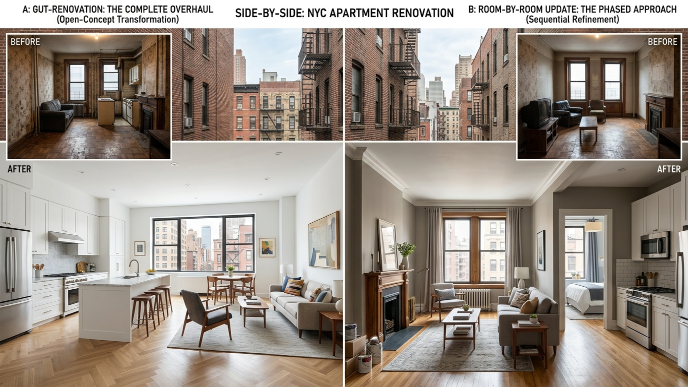
A homeowner in Crown Heights called us last spring. She had two contractor quotes on the table. One for $88,000. One for $310,000. Same apartment. Same list of complaints: an outdated kitchen, one failing bathroom, and plumbing that rattled every morning. Both contractors were licensed. Both quotes were real.
The difference was scope. One quoted a targeted room-by-room remodel. The other quoted a full gut renovation. She didn’t know which she actually needed — and neither contractor had given her a clear reason to pick one over the other.
This is the most consequential decision most NYC homeowners face. Get it wrong in either direction and it costs real money. A gut renovation you didn’t need runs $100,000–$200,000 more than a targeted remodel. A room-by-room fix on a pre-war apartment with original electrical and corroded pipes sets you up for the same work again in five years — at higher cost.
General Contractor NYC is a referral network — not a contractor. We connect Manhattan, Brooklyn, Queens, Bronx, and Staten Island homeowners with licensed, vetted contractors who assess your apartment honestly before quoting either option. This guide tells you what separates these two approaches and how to know which fits your situation.
What a Gut Renovation Actually Means in NYC
A gut renovation strips an apartment to its structural frame. Walls come down to the studs. Ceilings open. Every mechanical system — electrical, plumbing, HVAC — is exposed, replaced, and rebuilt. The floor plan can change. Room locations, sizes, and functions are all back on the table.
Under the NYC Department of Buildings, a gut renovation is classified as a Major Alteration. It requires architectural plans drawn by a licensed architect or PE, DOB permit filings, and mandatory inspections at multiple construction stages. This process doesn’t begin on demo day. It begins months earlier, with drawings and approvals.
Pre-1987 buildings — which includes most pre-war apartments in Manhattan, Park Slope, Astoria, and across the five boroughs — require asbestos testing before any demolition filing. Asbestos is common in pre-war plaster, joint compound, and vinyl flooring materials. If it’s present and the work disturbs it, licensed abatement is required. Budget $3,000–$8,000 for testing and clearance.
Soft costs add up before a single wall comes down. Architectural drawings, DOB filing fees, a registered architect or PE, and required special inspections together run $10,000–$25,000 in most Manhattan projects.
Timeline from permit approval to completion: 4–9 months for most apartments. Add 6–12 weeks for DOB permit processing before that. For co-op apartments, add another 2–6 weeks for alteration agreement board review before work can legally begin.
What a Room-by-Room Remodel Looks Like
A room-by-room remodel targets specific spaces without opening the entire apartment. Walls stay closed. Existing plumbing and electrical are reused where they’re in sound condition. The kitchen is rebuilt. One bathroom is upgraded. A non-load-bearing wall comes down in the living area. The rest of the apartment stays.
This approach doesn’t require full architectural plans in most cases. A DOB permit is still required for any electrical, plumbing, or structural work — but the filing scope is smaller and approval is faster. Permit processing typically runs 2–5 weeks instead of 6–12.
For co-op buildings, a targeted remodel usually means a shorter alteration agreement. The board isn’t reviewing a full systems overhaul. They’re reviewing a defined, limited scope. That review tends to move faster and with less friction.
Room-by-room renovation can also be phased. Tackle the kitchen this year. Renovate the primary bathroom in two years. Refresh the living room after that. Spreading the work spreads the cost — and reduces the disruption that comes with construction in an occupied apartment.
Timeline per room: 3–8 weeks from permit approval, depending on scope and complexity. A kitchen remodel typically runs 4–8 weeks. A bathroom runs 3–6 weeks.
NYC Gut Renovation vs. Room-by-Room: What the Numbers Show
Cost is the fastest way to frame this decision. Here’s how the two approaches compare in 2026.
| Cost Item | Gut Renovation (Manhattan) | Room-by-Room (Manhattan) |
|---|---|---|
| Construction (per sq ft) | $200–$400 mid-range | Varies by room — see below |
| 800 sq ft apartment | $160,000–$320,000 | $80,000–$165,000 (kitchen + 2 baths) |
| 1,200 sq ft apartment | $240,000–$480,000 | $95,000–$190,000 (kitchen + 2 baths + living room) |
| Architectural plans + DOB filing | $10,000–$25,000 | $2,000–$8,000 |
| Asbestos testing (pre-1987 buildings) | $3,000–$8,000 required | $1,000–$3,000 if walls open |
| Timeline to completion | 10–18 months total | 2–4 months per room |
| Brooklyn / Queens discount | 20–30% lower on construction | 15–25% lower per room |
Room-by-room cost by space in Manhattan:
- Kitchen: $35,000–$75,000 (mid-range, no plumbing relocation)
- Primary bathroom: $20,000–$55,000
- Secondary bathroom: $15,000–$35,000
- Living room (open wall, flooring, electrical): $20,000–$45,000
The comparison shifts when three or more rooms need significant work at the same time. At that point, the gut renovation’s per-square-foot cost — spread across a fully replaced system — often closes the gap with three separate room-by-room projects. Contractor mobilization, scaffolding, and site overhead are fixed costs. Running them once for a full gut is cheaper than paying them three times over three projects.
5 Situations Where a Gut Renovation Is the Right Call
A gut renovation isn’t a preference. For certain apartments, it’s the only path that makes financial sense long term.
- Original pre-war plumbing or electrical is still in use. Cloth wiring from the 1940s and 1950s won’t pass inspection. Galvanized pipes corrode from the inside — the exterior looks fine while water pressure drops. A room-by-room renovation that opens walls will expose these systems anyway. Replacing them mid-project costs more than accounting for them upfront.
- Three or more rooms need significant work at the same time. Contractor mobilization, site setup, and overhead costs are fixed. Running a single project for the full apartment is cheaper than three sequential projects with three sets of setup costs.
- The layout no longer functions and walls need to move. Load-bearing wall modifications, plumbing relocations, and major layout reconfigurations require a full permit set and architectural plans. At that point, you are already in gut renovation territory from a cost and permitting standpoint. Treating it as a partial project adds cost without reducing it.
- You’re planning to stay for 10 or more years. A gut renovation resets all mechanical systems for a full cycle — typically 25–40 years for electrical, plumbing, and HVAC. For long-term owners, this eliminates the risk of a systems failure mid-ownership.
- The apartment is in estate condition. An apartment untouched since the 1970s or early 1980s rarely makes economic sense for room-by-room work. Every system is approaching the end of its useful life simultaneously. Starting fresh is cheaper than chasing individual failures.
5 Situations Where Room-by-Room Makes More Sense
Most NYC homeowners don’t need a gut renovation. They need the right rooms done correctly — and a contractor experienced enough to tell them the difference.
- Your total budget is under $150,000. A full gut renovation in a Manhattan apartment rarely comes in under $180,000 once soft costs are included. If $150,000 is your ceiling, a room-by-room approach is your realistic path. A targeted kitchen and bathroom renovation delivers visible improvement within that budget.
- You can’t vacate the apartment during construction. A gut renovation is not a live-in project. Full gut work exposes structural elements, leaves no usable space, and creates conditions that are unsafe to live in. If you cannot move out for 4–9 months, the decision has been made for you.
- Your co-op board restricts renovation scope or hours. Some co-op buildings in Manhattan and Brooklyn limit construction to Monday–Friday, 9am–5pm, with no exceptions. Extended projects create extended friction with the board and neighbors. A targeted renovation completes faster and creates less exposure.
- One or two rooms are the problem. If the kitchen is failing and the rest of the apartment is functional, fix the kitchen. A gut renovation to solve one room’s problems is expensive by definition and unnecessary in practice.
- You plan to sell within 3–5 years. Targeted kitchen and bathroom renovations generally offer better ROI on a shorter ownership timeline than a full gut. A gut renovation’s returns amortize over a longer hold period. If you’re selling in 3–5 years, precision beats totality.
NYC-Specific Factors That Change This Decision
NYC adds complexity that doesn’t exist in most other markets. These factors affect both renovation types — but they affect gut renovations more significantly.
Co-op Alteration Agreements
If you own a co-op — in Manhattan, Brooklyn, or Queens — any renovation requires board approval through an alteration agreement before work begins. Gut renovations trigger a more detailed review. The board examines architectural plans, requires elevated insurance ($1M–$2M general liability, naming the building as additional insured), and typically requires a renovation deposit of $2,000–$5,000, returned on clean completion. Room-by-room projects get through this process faster and with less board scrutiny.
The “Wet Over Wet” Rule
Many NYC buildings — particularly co-ops — prohibit moving plumbing above a neighbor’s kitchen or bathroom. This is called the wet-over-wet rule. It prevents flooding risk to downstairs units. If your gut renovation plan requires relocating a bathroom or kitchen, confirm this is permitted under your building’s alteration agreement before proceeding. This restriction can block certain layouts entirely, regardless of what you want to build.
Pre-War Building Surprises
The moment walls open in a pre-war building, conditions emerge that weren’t visible from the surface. Contractors experienced with pre-war Manhattan and Brooklyn brownstones budget 15–20% contingency for gut projects as standard practice. Build this into the budget before signing any contract — not as a line item to add later if problems appear.
Chapter 24 Noise Rules
Construction noise in NYC is regulated under Local Law 24. Permitted hours are 7am–6pm Monday through Friday and 10am–4pm on Saturdays. Extended renovation projects mean extended compliance periods. For neighbors in your building and on your floor, a gut renovation’s 4–9 month timeline creates a very different friction than a 6-week kitchen remodel.
Not Sure Which Approach Fits Your Apartment?
We match Manhattan and NYC homeowners with licensed contractors who walk through your apartment first — before quoting either option. Get an honest assessment, not a sales pitch.
What the Right Contractor Does Before Quoting You
A contractor who quotes a gut renovation — or a room-by-room remodel — without walking through the apartment is guessing. The pre-quote walkthrough is where a competent contractor identifies the conditions that actually determine scope.
For pre-war buildings, they’re looking for: cloth wiring in the panel, galvanized or cast iron pipe conditions, the state of HVAC infrastructure, and visible water damage or structural movement. These findings move the conversation toward or away from a gut renovation with real data — not assumptions about what typically happens in old buildings.
Ask any contractor you’re considering for this: quote me both approaches. A full gut renovation estimate, and a targeted room-by-room estimate covering my specific problem areas. The price difference — and the explanation for it — tells you whether the contractor understands your building or is defaulting to the more profitable option.
Design-build firms have a financial incentive to recommend gut renovations. They make more money on larger projects. A referral network doesn’t. General Contractor NYC connects homeowners with licensed contractors whose job is to match the scope to the problem — not to expand it.
The contractors in our network are vetted before referral: NYC HIC license confirmed, insurance verified, track record with co-op and pre-war renovation reviewed. We match you with professionals who have worked through the DOB permit process, co-op board alteration agreements, and pre-war building conditions across Manhattan, Brooklyn, Queens, and the Bronx — hundreds of completed projects.
For more on how NYC renovation costs break down by project type, see our NYC general contractor cost guide. For a full overview of what the hiring process looks like, read how to hire a general contractor in NYC. Both are part of our NYC home renovation guide — the broader resource this article supports.
Frequently Asked Questions
How much does a gut renovation cost in a NYC apartment?
In Manhattan, mid-range gut renovations run $200–$400 per square foot for construction — before soft costs. For an 800 sq ft apartment, expect $160,000–$320,000 in construction, plus $10,000–$25,000 for architectural plans, DOB permits, and inspections. Brooklyn and Queens typically run 20–30% lower for the same scope. Pre-war buildings add 15–20% for hidden conditions behind walls.
How long does a gut renovation take in a NYC apartment?
From permit approval to completion, most Manhattan gut renovations take 4–9 months. Add 6–12 weeks for NYC DOB permit processing before that. Co-op buildings add 2–6 weeks for alteration agreement board review before work can legally start. Plan for 10–18 months total from decision to move-in. Starting the planning process 12 months before your target completion date is not excessive — it’s realistic.
Do I need a DOB permit for a gut renovation in NYC?
Yes. A gut renovation requires DOB permit filings with full architectural plans from a licensed architect or PE. It is classified as a major alteration under NYC Building Code and requires inspections at multiple construction stages. The contractor handles permit applications. The architectural drawings and DOB filings require a licensed registered design professional they work with — not a permit pulled at the permit office counter.
Can a co-op board block a gut renovation in NYC?
A co-op board can reject a renovation scope that doesn’t comply with the building’s alteration agreement — or require modifications before approving it. Common restrictions include wet-over-wet plumbing rules, limits on construction hours, insurance minimums, and renovation deposit requirements. Review your building’s alteration agreement with your managing agent before finalizing any gut renovation plan. A contractor experienced with co-ops knows how to structure scope for board approval.