
A client called us last year in a panic. Her Manhattan contractor had just walked off the job — three weeks into a kitchen renovation, walls opened, no permits pulled, and $28,000 gone. She had ignored every warning sign. We see this story more than you’d think.
Hiring a contractor in New York City is not like hiring one anywhere else. The rules are stricter. The stakes are higher. And because NYC projects involve co-op boards, NYC DOB permits, and dense building logistics, a bad contractor doesn’t just cause delays — they can get your project stopped by the city or flagged by your building.
Knowing the NYC contractor red flags before you sign a contract can save you tens of thousands of dollars and months of stress. Here are the 10 we see most often — and exactly what to do when you spot them.
Quick answer: The most dangerous NYC contractor red flags are: no HIC license, no proof of insurance, asking for more than 30% upfront, no permit plan, and no local NYC project history. Spot any one of these — walk away.
👉 Full guide: How to Hire a General Contractor in NYC — The Complete 2026 Guide
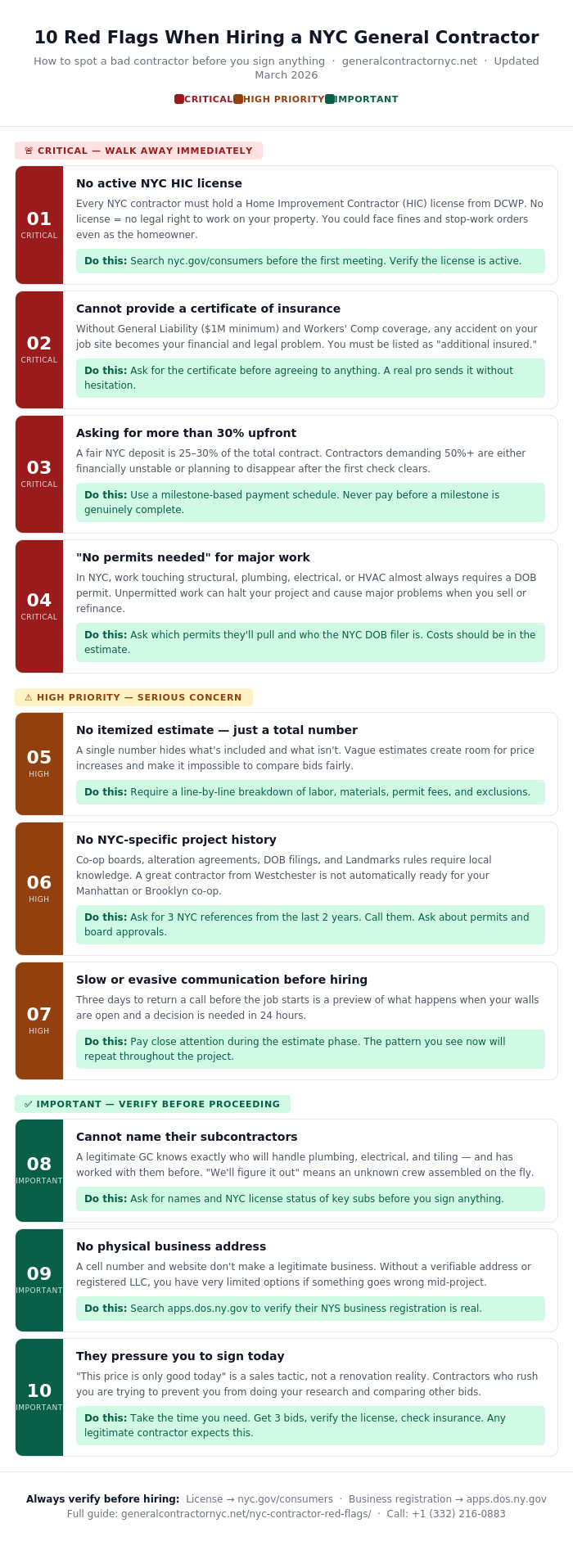
The 10 Red Flags — Ranked by Severity
Red Flag #1 — They Cannot Show You an Active NYC HIC License
Every contractor doing home improvement work in New York City must hold a Home Improvement Contractor (HIC) license from the NYC Department of Consumer and Worker Protection (DCWP). No license means no legal right to take on your project. If they get caught — and the city does check — you could face fines and stop-work orders even as the property owner.
Real example: We had a Tribeca homeowner come to us after her unlicensed contractor was flagged during a DOB inspection. Her project was shut down for six weeks while she sorted out liability.
What to do: Go to nyc.gov/consumers and search the contractor’s name or license number before the first meeting. If it’s not there or expired — end the conversation.
Red Flag #2 — They Cannot Provide a Certificate of Insurance
Accidents happen on job sites. A worker falls. A water line bursts. Without proper insurance, those costs land on you. A legit NYC contractor carries General Liability Insurance (minimum $1M per occurrence) and Workers’ Compensation Insurance. They should list you as “additional insured” on the certificate — not just hand you a document with their name on it.
Real example: A homeowner in the West Village hired an uninsured crew to redo her floors. One worker was injured. She spent two years in a legal dispute that cost her more than the renovation itself.
What to do: Ask for the certificate before you agree to anything. A real professional sends it without hesitation. If they stall, push back, or send an expired document — that is your answer.
Red Flag #3 — They Want More Than 30% Upfront
Legitimate NYC general contractors do not need you to fund their business before they’ve done any work. A fair deposit is 25–30% of the total contract. The rest should be tied to completed milestones — demolition done, rough inspections passed, finishes complete. Any contractor asking for 50% or more upfront is either financially unstable or planning to disappear.
Real example: One of the most common NYC contractor scam patterns: collect a large deposit, start work, then claim unexpected costs require another lump sum. By then, you’re stuck.
What to do: Include a milestone-based payment schedule in your contract. Never release funds before a milestone is genuinely complete. If they pressure you otherwise — walk.
Red Flag #4 — They Tell You “No Permits Needed” for Major Work
In New York City, most renovation work that touches structural elements, plumbing, electrical, or HVAC systems requires a DOB permit. A contractor who says “we don’t need permits for this” is either ignorant of NYC regulations or hoping you won’t find out until it’s too late. Unpermitted work in NYC can halt your project, reduce your property value, and cause serious problems if you ever sell.
Real example: A Park Slope homeowner got an open bathroom permit flagged during a refinancing appraisal. The unpermitted work had been done two years earlier by a contractor who “handled everything informally.”
What to do: Ask specifically — which permits will you pull for this project? Who is your NYC DOB filer? A good contractor will answer clearly and include permit costs in the estimate. See our full NYC DOB permits guide for homeowners.
Red Flag #5 — The Estimate Has No Itemized Breakdown
A single number on a piece of paper is not an estimate — it’s a guess. Real NYC renovation estimates break down labor, materials, subcontractor costs, permit fees, and what is explicitly not included. Vague estimates hide room for price increases and make it impossible to compare bids fairly.
Real example: We often see homeowners compare a $60,000 itemized bid against a $45,000 lump-sum bid. When you add in what the low bid excluded — permits, disposal, tile installation — the lump-sum job ends up at $65,000.
What to do: Require a line-by-line written estimate before making any decision. If a contractor won’t provide one, they’re either not organized enough to run your project or not planning to do what they quoted.
Red Flag #6 — They Have No NYC-Specific Project History
Renovating in New York City requires knowledge that contractors from outside the city simply don’t have. NYC DOB permit procedures, co-op and condo board alteration agreements, Landmarks Preservation rules, building management requirements — these are not things you learn from YouTube. A contractor with strong work history in New Jersey or upstate NY is not automatically qualified to work in your Manhattan or Brooklyn co-op.
Real example: We took over a project in the Upper West Side after the original contractor — excellent work history in Westchester — failed to navigate the building’s alteration agreement process twice. The project was delayed four months.
What to do: Ask for three references from NYC projects in the last two years. Call them. Ask specifically about the permit process and board approval experience.
Red Flag #7 — Communication Is Slow or Evasive Before You’ve Even Hired Them
How a contractor communicates during the sales process tells you exactly how they’ll communicate when your walls are open and a decision needs to be made in 24 hours. If they take three days to return a call before you’re a client, expect that to be the norm once you are. In a NYC renovation, slow communication causes expensive delays.
What to do: Pay attention during the estimate phase. Do they reply quickly? Do they answer your questions directly? If you’re already chasing them — trust that instinct.
Red Flag #8 — They Cannot Name Their Subcontractors
On any mid-size to large NYC renovation, your general contractor will hire specialty subcontractors — plumbers, electricians, tileworkers. A legitimate GC knows exactly who those people are, has worked with them before, and can tell you their license status. A contractor who says “we’ll figure that out as we go” is assembling your crew on the fly.
What to do: Ask directly — who will do the plumbing? Who handles electrical? Are they licensed NYC tradespeople? A confident GC will answer this without hesitation.
Red Flag #9 — There Is No Physical Business Address
A cell phone number and a website do not make a legitimate business. Contractors without a verifiable business address, registered LLC, or physical location in the NYC area are significantly harder to hold accountable if something goes wrong. You need to be able to find — and serve — them if a dispute arises.
What to do: Search the contractor’s business name in the NYS Division of Corporations database at apps.dos.ny.gov. Verify their address is real. A legitimate contractor will have a proper business registration.
Red Flag #10 — They Pressure You to Sign Today
Urgency is a sales tactic, not a renovation reality. “This price is only good today” or “I have another client ready to take this slot” are classic pressure plays. A contractor who needs to rush you into a decision is either trying to prevent you from doing your research or knows their bid won’t survive comparison.
Real example: We’ve heard from homeowners who signed under time pressure and later discovered the contractor had multiple DOB violations and zero HIC license.
What to do: Take the time you need. Get three bids. Check the license. Verify the insurance. Any legitimate contractor expects this process and welcomes it.
3 More Quick Warning Signs
- Their online reviews show a pattern of “project abandoned mid-way” or “deposit taken, never showed up” — not just one unhappy customer, but a repeating theme.
- They sublet your project to another crew without telling you. You hired them — you should know who is working in your home at all times.
- The contract has no change order clause. Any legitimate contract specifies that scope changes must be written and approved before work starts. Without this, verbal additions become billing disputes.
NYC-specific note: Co-op and condo buildings add another layer. Your contractor must understand your alteration agreement — work hours, elevator access, floor protection, insurance certificates naming your building. Always ask: “Have you submitted an alteration agreement before? Have you worked in a co-op?” See our guide to co-op and condo renovation rules in NYC.
Why Referral-Based Contractors Are Different
We run a referral-based general contracting business in New York City. That means we don’t spend money on advertising. We grow because homeowners refer their neighbors, friends, and family to us — and that only happens when the work is done right.
When your business depends entirely on referrals, you can’t afford a single project that goes sideways. Every job matters. That accountability changes how we work — and it’s the best guarantee a homeowner can have.
We’re fully licensed and insured, and we’re experienced with NYC DOB permits, co-op and condo alteration agreements, and all five boroughs. If you’re planning a renovation, contact us for a free, no-pressure consultation.
FAQs — NYC Contractor Red Flags
How do I check if a contractor is licensed in NYC?
Go to nyc.gov/consumers and search the contractor’s name or license number. You’ll see whether their NYC Home Improvement Contractor (HIC) license is active and whether any complaints have been filed against them.
What happens if I hire an unlicensed contractor in NYC?
You take on significant risk. If a worker is injured, you may be personally liable. If unpermitted work is discovered — during a sale, refinance, or DOB inspection — you can face fines, stop-work orders, and mandatory removal of the work. The contractor typically moves on. You’re left with the consequences.
Is it a red flag if a contractor asks for cash only?
Yes. Cash-only contractors are often unlicensed and uninsured. They avoid paper trails deliberately. A legitimate NYC contractor accepts checks, bank transfers, or credit card payments and provides proper receipts for every transaction.
How much deposit should I pay a NYC contractor?
25–30% is standard and fair in NYC. Never pay more than one-third upfront. All remaining payments should be tied to completed milestones — rough inspection passed, finishes installed, punch list done — not to calendar dates.
What should I do if a contractor walks off the job mid-project?
Document everything immediately: take photos, secure the job site, collect all receipts. File a complaint with NYC DCWP. If your contract was in writing, you may have grounds for a civil claim. Contact another licensed GC to assess the state of the work before starting anything new.