
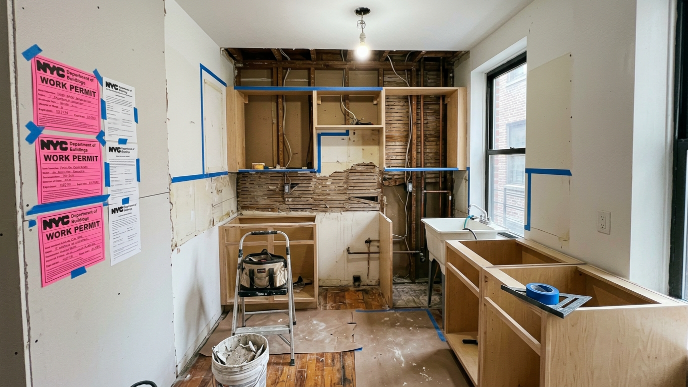
A Manhattan homeowner called us last spring with a problem. Her contractor had opened every wall in her kitchen. Then her co-op board found out she had no alteration agreement. Work stopped immediately. Walls stayed open for six weeks while the paperwork was sorted. The delay cost her $11,000 in extended contractor fees and temporary accommodation.
This is one of the ten most common NYC kitchen renovation mistakes. Some of them cost thousands. A few can stop a project entirely. All of them are avoidable if you know what to look for before work begins.
General Contractor NYC is a referral network. We connect Manhattan, Brooklyn, and Queens homeowners with licensed, vetted general contractors. The contractors we refer do the work. Our job is making sure you get someone qualified for your specific building and project type.
1. Starting Work Without Co-op Board Approval
This is the single most expensive mistake in NYC kitchen renovation. It applies to co-op apartments — which make up the majority of Manhattan’s housing stock.
Before any permitted work begins in a co-op, you must file an alteration agreement with the board. This document covers scope of work, insurance requirements, contractor credentials, and hours of operation. Boards in buildings across the Upper East Side, Upper West Side, and Park Slope review these carefully. Approval typically takes 2–6 weeks.
Working without approval risks a stop-work order from the building. The board can require work to be undone at your expense. No contractor can fix that after the fact. Check with your managing agent before signing any contractor agreement.
2. Skipping NYC DOB Permits for Work That Requires Them
Any kitchen work that touches plumbing, electrical, gas lines, or structural walls requires a permit from the NYC Department of Buildings (DOB). This includes moving a sink, adding a dedicated circuit for a dishwasher, or relocating a gas range.
The application goes through DOB NOW, the city’s online permitting portal. Most kitchen renovations require an Alteration Type 2 (Alt-2) filing. Processing time runs 3–8 weeks for standard applications. Expedited filing is available but adds cost.
Working without a permit creates three problems. First, the work can be flagged during a future sale — buyers’ attorneys check DOB records. Second, if something goes wrong (a leak, an electrical fault), your insurance may not cover unpermitted work. Third, the DOB can issue a violation and require demolition of the unpermitted work.
The contractor in our network handles permit applications. Verify this is included in any scope of work before signing. See the NYC Department of Buildings homeowner page for permit basics.
3. Hiring a Contractor Without a Current NYC HIC License
New York City requires any contractor doing home improvement work to hold a Home Improvement Contractor (HIC) license from the NYC Department of Consumer Affairs. This is separate from a state contractor license. Many contractors licensed in New Jersey or upstate New York do not hold a current NYC HIC license.
Verify any contractor’s HIC license at nyc.gov/dca before signing a contract. An HIC-licensed contractor is also required to meet the city’s insurance standards and give you a written contract.
Working with an unlicensed contractor leaves you with no recourse through the NYC Department of Consumer Affairs if problems arise. Every contractor in our network holds a current HIC license, verified before referral and checked annually.
Not sure if your contractor is HIC-licensed? We’ve already checked.
General Contractor NYC pre-verifies every contractor’s NYC HIC license, insurance, and co-op renovation experience before making any referral. Most homeowners hear back within 24 hours.
Get a Risk-Free Quote → Call (212) 464-8406
General Contractor NYC is a referral network. Independent licensed contractors provide quotes and complete all work.
4. Moving Plumbing Without Checking the Wet-Over-Dry Rule
This is a NYC-specific problem most homeowners don’t encounter until it’s too late.
Many co-op buildings prohibit placing a “wet” room — a space with plumbing — directly above a neighbor’s bedroom or living area. This is called the wet-over-dry rule. Moving your kitchen sink from one wall to another can violate it if the new location sits above a neighbor’s dry space.
Before finalizing any layout that moves plumbing, your contractor needs to review the building’s stack configuration. In some cases, a licensed engineer must assess feasibility. Finding out mid-renovation that the layout won’t be approved adds weeks and replanning costs. Find out before demolition begins.
5. Not Budgeting a 15–20% Contingency for Pre-War Buildings
Manhattan and Brooklyn have a large share of pre-war housing — buildings constructed before 1940. These kitchens regularly reveal problems once walls open: outdated knob-and-tube electrical wiring, lead pipes, asbestos tile under linoleum floors, or structural members in unexpected places.
A 15–20% contingency on top of your base budget is standard for pre-war kitchens. It is not pessimism — it reflects what contractors across our network see on these projects regularly. On a $45,000 kitchen renovation, that means keeping $6,750–$9,000 in reserve.
Post-war buildings (1940–1980) carry lower risk but still deserve a 10% contingency. New construction condos carry minimal hidden-condition risk but still face NYC-specific logistics costs.
6. Starting Demo Before All Materials Have Delivery Dates
Custom kitchen cabinets have lead times of 8–16 weeks from most NYC-area suppliers. Semi-custom runs 4–8 weeks. Specialty tiles, countertops cut to size, and imported fixtures add more time.
Starting demolition before materials are ordered — and confirmed with verified delivery dates — means paying a crew to stand around in a gutted kitchen. In NYC, day rates for kitchen crews run $1,500–$3,000. A four-week materials delay adds $6,000–$12,000 in holding costs on top of the delay itself.
Ask your contractor for a written schedule that shows when each material must be ordered to keep construction moving. This is a basic project management step. Any experienced NYC kitchen contractor should produce it without being asked.
7. Ignoring Building Access Rules and Logistics
NYC apartment buildings have renovation rules that don’t exist anywhere else. Most Manhattan co-ops and many condos require:
- Elevator booking: freight elevator access must be scheduled weeks in advance in larger buildings
- Renovation deposits: typically $500–$2,000, returned on completion, but held by the building during the project
- Noise hours: NYC’s Chapter 24 noise ordinance limits construction noise to 7am–6pm Monday–Friday and 10am–4pm Saturday. Some co-ops are stricter.
- Superintendent coordination: plumbing shutoffs require advance notice and building staff presence
- Common area protection: hallways and elevator cabs must be padded during material delivery
A contractor without experience in NYC apartment buildings will get at least one of these wrong. The result is fines, stop-work orders, or a building management complaint. Ask any contractor you’re considering: have they completed projects in your building type? Can they name a specific co-op or condo building in your neighborhood where they’ve worked?
For more on what separates a competent NYC contractor from a risky one, read our guide on 10 red flags when hiring a NYC general contractor.
8. Getting Only One Contractor Quote
In NYC, quotes for the same kitchen renovation scope regularly vary by 40–60%. A $38,000 quote and a $62,000 quote for identical work are not unusual. The gap isn’t always dishonesty — it reflects different subcontractor relationships, material sourcing, overhead structures, and how the contractor reads the risk in your specific building.
Getting only one quote leaves you with no context. You don’t know whether the number is fair, whether the scope is complete, or whether critical items are missing. You need at least two written, itemized quotes to make a sound decision.
When comparing quotes, look at what each one excludes. NYC kitchen renovation quotes frequently omit permit filing fees, DOB expediter costs, alteration agreement filing fees, and demolition disposal. A quote that looks $10,000 lower may include $8,000 less in scope.
9. Skipping Electrical Capacity Verification Before Specifying Appliances
This mistake is increasingly common as induction cooktops replace gas ranges in NYC apartments. An induction cooktop at full power draws 7–9 kilowatts. Combined with a dishwasher, refrigerator, microwave, and under-cabinet lighting, a modern kitchen easily exceeds what older panels can handle.
Many pre-war and early post-war kitchens run on 60-amp service — not enough for this load. Finding this out after you’ve ordered appliances and finalized the design means a change order for panel upgrade work, an additional electrical permit, and added weeks to the schedule.
A licensed electrician should evaluate your panel capacity before you finalize the appliance specification. This takes one site visit. It prevents a costly mid-project change order. The contractors in our network include this step in the initial walkthrough for any kitchen project involving appliance changes.
10. Underestimating the Real Timeline From Start to Completion
NYC kitchen construction typically takes 4–8 weeks. But that clock doesn’t start when you hire a contractor. The full timeline looks like this:
| Phase | Typical Duration | Notes |
|---|---|---|
| Co-op/condo board approval | 2–6 weeks | Required before any permitted work begins in most buildings |
| Materials ordering (cabinets, countertops, tile) | 4–16 weeks | Must be ordered before or alongside permit filing |
| NYC DOB permit processing (Alt-2) | 3–8 weeks | Via DOB NOW; expediting available at added cost |
| Kitchen construction | 4–8 weeks | From permit issuance and materials delivery, not from project start |
| Final inspection and sign-off | 1–2 weeks | Required for permitted work; inspectors schedule through DOB NOW |
Total realistic timeline from contractor selection to completed kitchen: 4–6 months for most Manhattan projects. Plan accordingly. If someone tells you they can complete your Manhattan kitchen renovation in six weeks from first call, ask them to show you how that accounts for board approval and permit processing. The answer will tell you everything.
For a full breakdown of what drives kitchen renovation costs in NYC, see our NYC kitchen renovation cost guide, which covers per-scope pricing, borough variations, and what affects the final number.
Frequently Asked Questions About NYC Kitchen Renovation Mistakes
Do I need a NYC DOB permit to renovate my kitchen?
Yes, if the work involves plumbing, electrical, gas lines, or structural changes. Moving a sink, adding a dishwasher circuit, or removing a non-structural wall all require an Alteration Type 2 permit filed through NYC DOB NOW. Cosmetic work — painting, cabinet door replacement, new countertops in the same location — typically does not require a permit. Always confirm with your contractor and your building’s managing agent before starting.
How long does NYC co-op board approval take for a kitchen renovation?
Typically 2–6 weeks, depending on the building. You must submit a complete alteration agreement package: signed agreement, contractor’s NYC HIC license, certificate of insurance naming the building as additional insured, and architectural drawings if the scope involves structural or plumbing changes. Submitting an incomplete package restarts the clock. Plan for this approval before scheduling any contractor start date.
How much should I budget for contingency on an NYC kitchen renovation?
15–20% for pre-war buildings (built before 1940), where hidden conditions — outdated electrical, lead pipes, asbestos tile — are common once walls open. 10% for post-war buildings. On a $50,000 Manhattan kitchen renovation, that means keeping $5,000–$10,000 in reserve. Do not treat the contingency as part of the design budget. It exists for conditions discovered during construction, not upgrades you decide to add later.
What is the realistic timeline for a Manhattan kitchen renovation?
4–6 months from contractor selection to completed kitchen is realistic for most Manhattan co-op projects. Construction itself takes 4–8 weeks. But co-op board approval adds 2–6 weeks, NYC DOB permit processing adds 3–8 weeks, and custom cabinetry lead times add 8–16 weeks — most of which runs in parallel. Anyone promising a full kitchen renovation in 6 weeks from first call is not accounting for NYC’s regulatory and logistics reality.
How do I verify a kitchen contractor’s NYC HIC license?
Go to nyc.gov/dca and search the contractor’s business name or license number. A valid NYC Home Improvement Contractor license is separate from any state license. Verify the license is current and active — not expired. Also confirm the contractor carries general liability insurance of at least $1 million per occurrence and can provide a certificate naming your building as additional insured, which most NYC co-ops require before work begins.